
On this page
- Breeding cycle at a glance
- When mating season occurs
- Why males fight
- Courtship and mating behavior
- How females select nesting sites
- When females lay their eggs
- Nesting and guarding behavior
- Incubation period
- When hatchlings emerge
- Why young dragons live in trees
- Survival challenges for young dragons
- What visitors may realistically observe
- Responsible wildlife-viewing rules
- Frequently asked questions
- Scientific sources and further reading
Komodo Dragon Breeding Cycle at a Glance
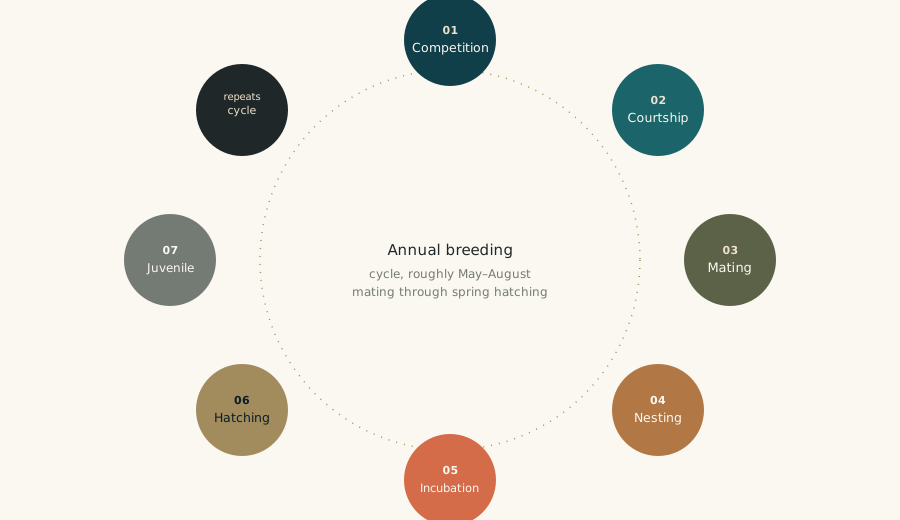
The Komodo dragon’s breeding cycle runs on an annual rhythm tied to the region’s dry and wet seasons. Rival males compete for access to females during the dry months, mating follows, females dig nests and lay eggs before the wet season sets in, and incubation stretches across roughly seven to eight months before hatchlings emerge the following year.
- Fighting and courtship
- Roughly May to August
- Egg laying
- Typically around September
- Incubation length
- Approximately 7–8 months
- Hatching
- Commonly around April, the following year
The diagram below shows how the stages connect across the year.
When Komodo Dragon Mating Season Occurs
Mating season in Komodo National Park generally falls within the dry season, roughly May through August, when the savanna is at its driest and open ground makes it easier for dragons to move, forage and encounter one another. This timing lines up with a broader pattern among the park’s wildlife, where dry-season conditions concentrate animal activity around limited water and food sources.
Because dragons are wide-ranging, solitary animals for most of the year, the breeding season is one of the few periods when individuals interact with each other more than briefly. Males actively search out receptive females, and that search is what drives the competitive behavior covered below.
Why Male Komodo Dragons Fight
Male Komodo dragons compete directly for access to females, and that competition can escalate into physical fights. Rival males rear up on their hind legs, using their tails for balance, and grapple with their forelimbs in an attempt to throw the other to the ground. These bouts can be intense and occasionally result in injury, though they are more accurately understood as ritualized dominance contests than random aggression.
Size and strength matter in these contests. A male that successfully dominates a rival gains the opportunity to court and mate with a nearby female, while the loser typically withdraws rather than risk further injury. This dynamic mirrors combat behavior seen in several other monitor lizard species, where physical dominance functions as the primary way males establish breeding access in the absence of complex social hierarchies.
A note on tone
Do not sensationalize what this looks like in the wild: these are natural dominance contests, not staged spectacles, and visitors should not expect or seek out a fight to witness.
Courtship and Mating Behavior
Once a male has established access to a female, courtship follows a pattern common to many monitor lizards. The male uses his tongue to pick up chemical cues from the female, tracks her movements closely, and may rub his chin along her body and neck as part of courtship contact. This behavior can continue over an extended period before mating actually occurs.
Female Komodo dragons are not always immediately receptive, and courtship can include a degree of resistance before a pair mates. Because dragons do not form lasting pairs or social bonds, courtship and mating are best understood as a brief seasonal interaction rather than a relationship that continues beyond the breeding period.
How Females Select Nesting Sites
After mating, female Komodo dragons look for a nesting site that will keep their eggs at a stable temperature and protect them from predators, including other dragons. Research on the species has documented females using abandoned nesting mounds built by orange-footed scrubfowl, a megapode bird that constructs large mounds of soil and vegetation for its own eggs. These mounds offer ready-made insulation and structure that a female dragon can adapt for her own use.
Where scrubfowl mounds are not available, females dig their own nest burrows into slopes or open ground, sometimes excavating multiple test holes before settling on a final site. Nest location matters for both temperature regulation during incubation and protection from flooding during the wet season that follows.
When Females Lay Their Eggs
Egg-laying typically follows mating by several weeks, commonly falling around September, toward the end of the dry season. A clutch generally contains close to twenty eggs, though clutch size can vary between individual females. The eggs are soft-shelled, similar to those of other large monitor lizards, and depend entirely on the surrounding nest material for protection and temperature stability.
Nesting and Guarding Behavior
Female Komodo dragons show a period of nest attendance after laying, remaining near the nest site for an extended stretch of time. This guarding behavior is thought to help deter potential threats to the eggs, including other dragons, since Komodo dragons are known to prey on eggs and hatchlings of their own species when the opportunity arises. Over time, as incubation continues, the female’s presence near the nest becomes less constant.
Incubation Period
Incubation is long by reptile standards, generally cited at around seven to eight months. This extended period means eggs laid near the end of the dry season remain buried through the entire wet season that follows, with the surrounding soil and nest material buffering the eggs from temperature swings and heavy rainfall.
Because incubation depends on ambient conditions inside the nest rather than active parental warming, nest site selection covered above has a direct effect on whether a clutch survives to hatching.
When Hatchlings Emerge
Hatching commonly occurs around April, near the start of the following dry season. Hatchlings use an egg tooth to break out of the shell and then dig their way up through the nest material to the surface, a process that itself can take time and leaves them vulnerable during the transition. Newly hatched dragons are fully independent from birth, receiving no parental care once they emerge.
Why Young Komodo Dragons Spend Time in Trees
Hatchling and juvenile Komodo dragons are proficient climbers, and they spend a significant portion of their early life in trees. This arboreal habit is a direct survival strategy: adult Komodo dragons are too large and heavy to climb effectively, so trees offer young dragons a refuge from the same species that poses one of their greatest threats, along with other ground-based predators.
Young dragons also feed differently from adults during this stage, taking insects, small reptiles and other prey suited to their smaller size, gradually shifting toward the ground-based, larger-prey diet associated with adult dragons as they grow.
Survival Challenges for Young Dragons
Juvenile mortality is high. Predation from adult Komodo dragons, including cannibalism, is one of the most significant pressures young dragons face, alongside other predators and the general difficulty of securing enough food while remaining small and vulnerable. Spending years in the tree canopy before becoming large enough to move safely on the ground is a direct response to this pressure, and it is one of the more distinctive features of the species’ life cycle compared with other large reptiles.
What Visitors May Realistically Observe
Visitors to Komodo National Park should not expect to witness fighting, mating, nesting or hatching directly. These are seasonal, often localized behaviors that occur on the animals’ own timeline, not a scheduled display. What a ranger-guided walk can realistically offer is a chance to see adult dragons resting, moving through their habitat, or occasionally interacting at a safe distance — and rangers are often a good source of general, current information about recent activity in the areas they patrol.
No sightings are guaranteed
This guide does not guarantee wildlife sightings of any kind. Komodo dragons are wild animals moving through open habitat, and what any individual visitor sees will vary.
Responsible Wildlife-Viewing Rules
- Stay with your ranger and keep the distance they instruct at all times.
- Never approach a dragon that is resting, feeding or appears agitated.
- Do not bring food into viewing areas or attempt to attract dragons in any way.
- Keep voices low and movements calm around any wildlife encounter.
- Photograph from where you are standing rather than moving closer for a better angle.
For a fuller treatment of these principles across the whole park, see Travel Komodo Without Leaving Harm Behind.
Frequently Asked Questions
When is Komodo dragon mating season?
Mating behavior is generally associated with the dry season, roughly May through August, with egg-laying following around September.
Do Komodo dragons lay eggs?
Yes. Female Komodo dragons lay a single clutch of eggs each breeding season, commonly around September, after mating during the dry-season months.
Where do Komodo dragons lay their eggs?
Females often use abandoned nesting mounds built by orange-footed scrubfowl, a megapode bird, adapting the ready-made mound for their own eggs. Where no such mound is available, a female digs her own nest burrow into a slope or open ground.
How many eggs does a Komodo dragon lay?
Clutches are commonly cited at around twenty eggs, though the exact number varies between individual females.
What is the incubation period for Komodo dragon eggs?
Incubation is typically around seven to eight months, meaning eggs laid near the end of the dry season stay buried through the entire wet season that follows, with hatching commonly occurring around April.
How do Komodo dragon hatchlings break out of their eggs?
Hatchlings use an egg tooth to break through the shell, then dig their way up through the surrounding nest material to reach the surface — a process that itself takes time and leaves them vulnerable during the transition.
What is the life cycle of a Komodo dragon?
In broad strokes: adult males compete and court females during the dry season, mating and egg-laying follow around September, eggs incubate for roughly seven to eight months, hatchlings emerge around the following April, and young dragons then spend an extended period living mostly in trees before growing large enough to move safely on the ground as adults.
Do Komodo dragons care for their young?
No. Hatchlings are independent from birth and receive no parental care. Young dragons also face a real risk of predation from adult dragons, including their own mother.
Can visitors see Komodo dragons mating or hatching?
It is highly unlikely. These behaviors are seasonal and largely unpredictable, and no responsible operator or ranger can guarantee a sighting of any specific behavior.
Scientific Sources and Further Reading
This guide draws on published research and established conservation references on Varanus komodoensis, including work on Komodo dragon reproductive biology, venom research, and IUCN and UNESCO reference material on the species and its habitat. See Sources and Methodology for how this site approaches research and citation generally.
- IUCN Red List species assessment for Varanus komodoensis
- UNESCO World Heritage Centre entry for Komodo National Park
- Peer-reviewed research on Komodo dragon reproduction, nesting behavior and venom biology