
On this page
What Is a Komodo Dragon?
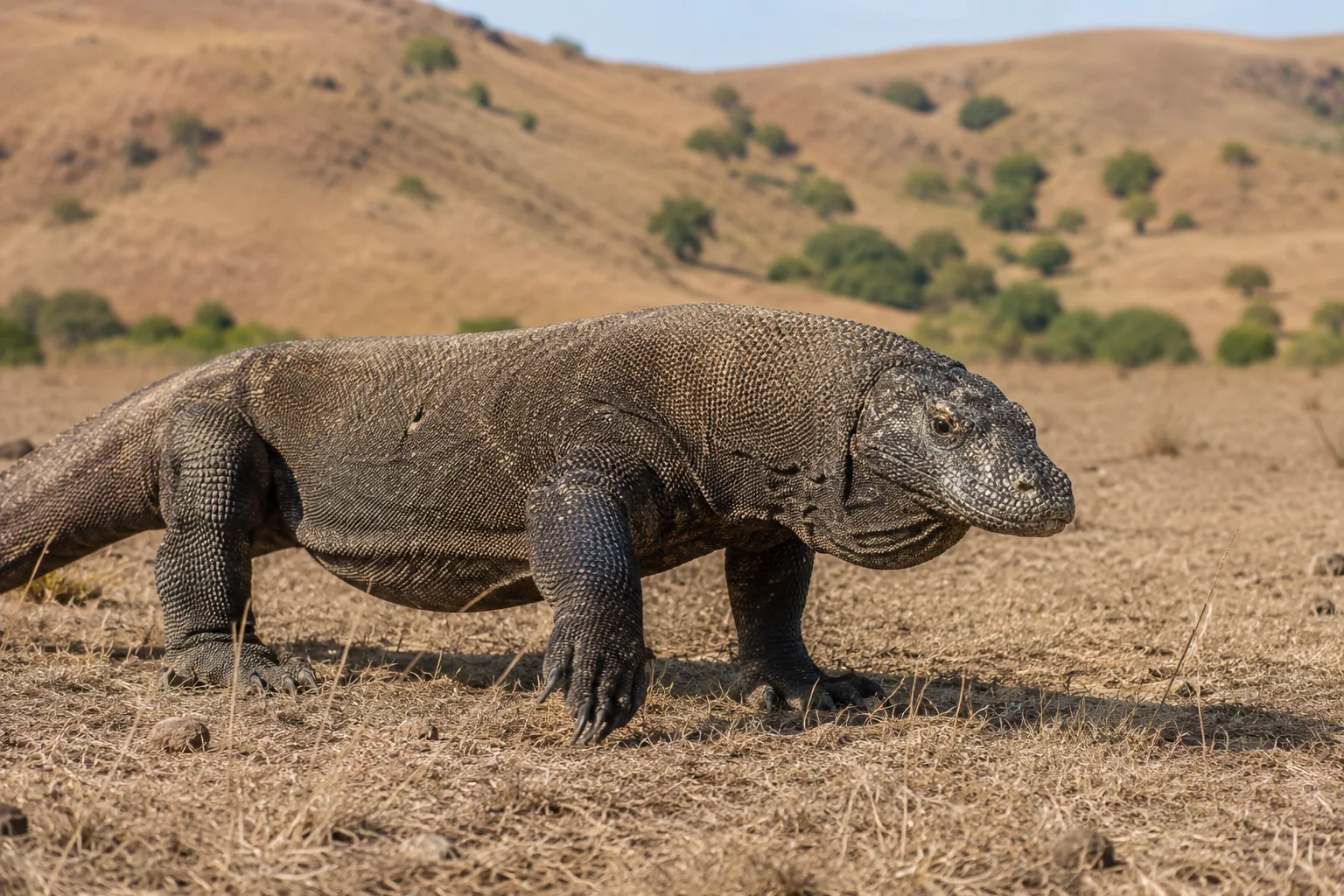
The Komodo dragon, Varanus komodoensis, is the largest living species of lizard, and a member of the monitor lizard family. It is endemic to a small number of islands in eastern Indonesia, meaning it occurs naturally nowhere else on Earth. Adults are powerful, ground-dwelling predators capable of taking prey considerably larger than themselves, and the species has drawn scientific and public fascination for over a century.
Despite the name, Komodo dragons are not mythical or fictional — they are real, living animals shaped by isolation on a small island chain, a phenomenon sometimes associated with unusually large body size in reptiles confined to limited landmasses.
Where Komodo Dragons Live
Wild populations are restricted to Komodo Island, Rinca Island, Flores, Gili Motang and a few smaller surrounding islands, all within Indonesia’s East Nusa Tenggara province in the Lesser Sunda Islands. Most of this range falls within or near Komodo National Park, which was established to protect the species and its habitat.
This naturally limited range is one reason the species is considered vulnerable to environmental change, habitat pressure and human activity, despite being an apex predator with no natural predators of its own as an adult.
Habitat and Daily Behavior
Komodo dragons move between several habitat types depending on season and prey availability, including dry savanna grassland, monsoon forest, and beach or coastal ridges. They are strong swimmers and have been recorded moving between neighboring islands in the wild.
Dragons are most active during the cooler parts of the day, resting in burrows or shaded areas to avoid the most intense heat. They dig or use burrows both for shelter and, in the case of females, for nesting.
Size, Senses and Physical Traits
Adult Komodo dragons commonly reach around three meters in length, with a heavy, muscular build, powerful limbs and a long, thick tail used for both balance and, during fights between males, as a brace. Their skin is covered in bony deposits called osteoderms, giving mature individuals a naturally armored quality.
Komodo dragons rely heavily on smell, using a forked tongue to collect airborne particles and an organ in the roof of the mouth to interpret them, in a manner similar to snakes. This sense of smell allows them to detect carrion from a considerable distance. Research published in the 2000s also confirmed that Komodo dragons possess venom glands, which contribute to their ability to subdue prey alongside their bite mechanics and hunting behavior.
Diet and Hunting
Komodo dragons are carnivorous and opportunistic, feeding on both carrion and live prey. Wild diets include deer, wild pig, water buffalo, smaller reptiles, and occasionally other Komodo dragons, particularly juveniles. Adult dragons are capable of ambushing prey much larger than themselves, using a combination of a powerful bite, sharp serrated teeth, and their venom to weaken and eventually subdue larger animals.
Because dragons can consume a very large single meal and then go without eating again for some time, feeding is often opportunistic rather than constant, and carrion scavenged from carcasses forms a meaningful part of their diet alongside active hunting.
Breeding, Nesting and Young
Breeding follows an annual, seasonal pattern tied to the dry and wet seasons, from male competition and courtship through nesting, an extended incubation period, and hatching roughly seven to eight months later. Hatchlings are independent from birth and spend much of their early life in trees, a strategy that helps protect them from ground-based predators, including adult dragons of their own species.
For the full breeding cycle, including nesting site selection, incubation timing and hatchling survival, see our dedicated guide: Inside the Komodo Dragon Mating, Nesting and Hatching Cycle.
Conservation Status
The Komodo dragon is listed as Endangered on the IUCN Red List, reflecting its restricted range, vulnerability to habitat change, and sensitivity to threats such as sea-level rise affecting low-lying island habitat, human encroachment, and prey availability. Komodo National Park, established in 1980 and recognized as a UNESCO World Heritage Site in 1991, exists specifically to protect the species and the wider ecosystem it depends on.
On population statistics
Population figures for wild Komodo dragons are periodically reassessed by conservation authorities and can vary between sources and survey years. Rather than cite a specific number here, we point readers to the IUCN Red List for the current official assessment.
Seeing Dragons Responsibly
Every dragon encounter inside the national park happens under the guidance of a park ranger. This is a safety requirement, not a formality: Komodo dragons are wild, powerful predators, and rangers are trained to read animal behavior and maintain a safe distance for both visitors and the dragons themselves.
- Stay with your ranger group at all times during a guided walk.
- Keep the distance instructed, especially around resting or feeding dragons.
- Do not bring food or attempt to attract wildlife in any way.
- Photograph calmly from where you are standing, not by moving closer.
For the fuller set of principles across the whole park, see Travel Komodo Without Leaving Harm Behind.
Frequently Asked Questions
Are Komodo dragons dangerous to humans?
Yes. They are large, powerful predators with a bite that combines mechanical damage and venom. This is why all viewing inside the park happens under ranger guidance and at a controlled distance.
How long do Komodo dragons live?
Estimates for wild lifespan vary by source; rather than cite an unverified figure, we recommend checking current IUCN or peer-reviewed sources for the latest estimates.
Can I see a Komodo dragon outside the national park?
Wild dragons are restricted to a small number of islands within their natural range, primarily inside or adjacent to Komodo National Park.
Do Komodo dragons only eat carrion?
No. They both scavenge carrion and actively hunt live prey, including animals considerably larger than themselves.
Sources and Further Reading
- IUCN Red List species assessment for Varanus komodoensis
- UNESCO World Heritage Centre entry for Komodo National Park
- Peer-reviewed research on Komodo dragon venom biology, ecology and behavior
See Sources and Methodology for our general research approach.

Social Behavior and Territory
Komodo dragons are largely solitary outside the breeding season, coming together mainly to compete for mates or to feed at a shared carcass, where a rough size-based hierarchy determines feeding order. Encounters between dragons, particularly males, can involve ritualized dominance displays and physical contests, covered in more depth in our guide to the mating, nesting and hatching cycle.